
A Guide to Entry Level Data Analyst Salary And How to Negotiate was originally published on Springboard Blog. (December 17, 2023)
- Finance, Healthcare, and Retail sectors offer the highest entry-level pay, and top companies like HSBC, Amazon, and EY are key employers for fresh graduates.
- Successful salary negotiation for entry-level data analyst roles starts with thorough research using platforms like Glassdoor, PayScale, and LinkedIn.
- As an entry level data analyst, it’s important to set up reasonable expectations in terms of compensation, perks, and benefits in order to negotiate your salary.

Photo by Tima Miroshnichenko
What’s the Entry Level Data Analyst Salary?
Entry level data analysts are individuals who have recently graduated from the university and are now in search of their very first stable data analyst job. These roles typically require a bachelor’s degree in a related field such as mathematics, statistics, computer science, or economics. Entry-level data analysts can gain valuable experience and enhance their skills while working alongside experienced professionals. The entry level data analyst salary is something that people rarely want to discuss unless they are keen on pursuing a career in the senior analyst job roles in the future.
Entry level data analysts don’t do the same amount and quality of work as senior analysts! Just like any other job role, data analyst salaries also depend on various factors like your total experience in the industry, the experience level of specific data analytics skills, location, industry, and others. The exact data analyst salary figures also vary to a great extent depending on the source, however, this should give you a good idea of the entry level data analyst salary you can expect. Remember, your data analysis skills as an entry level professional are valuable, and you deserve a decent salary.
Entry Level Salary – Industry Averages
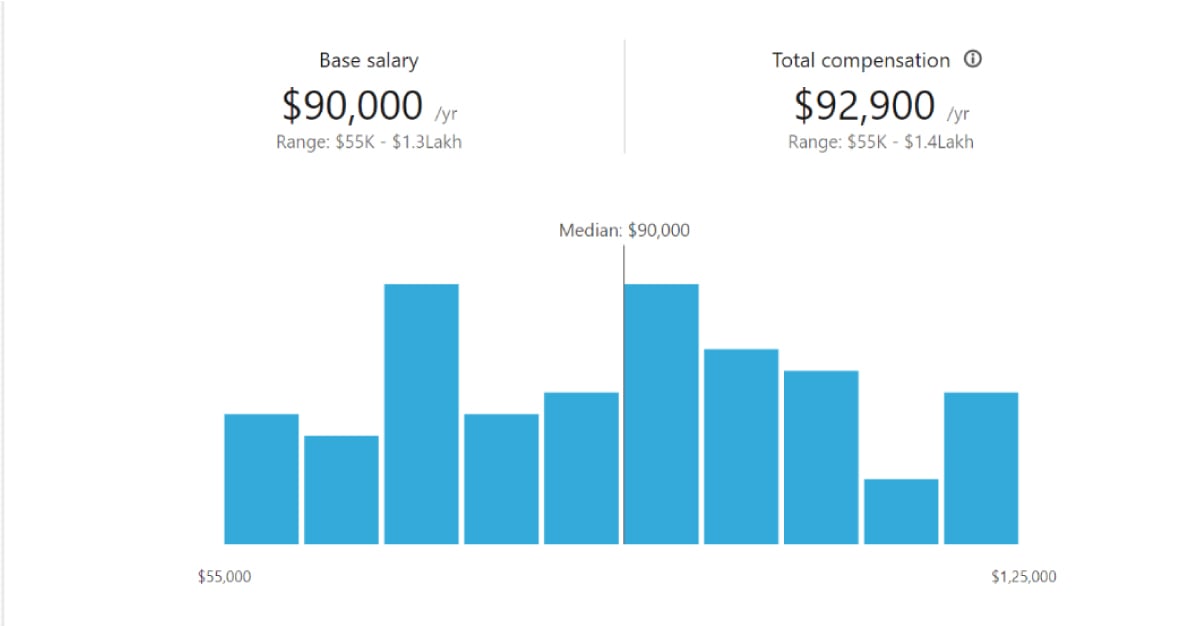
According to the LinkedIn community‘s labor statistics, the average data analyst salary in the US is $90,000 per year. Data analysts can earn up to $125,000 per year based on experience, location, industry, company type, etc. Data analysts can also get annual bonuses and sign-on bonuses over and above your salary. Google the average data analyst salary to find out what a fair offer is and aim for the highest paying offer. Remember, your job outlook is great, so data analysts don’t have to settle for less than average salaries. Negotiate with human resources!
The Robert Half Technology Salary Guide 2022 found that the average salary for an entry-level data analyst is $116,375 per year. Professionals with exceptional skills and niche experience can earn as much as $167,913 per year.
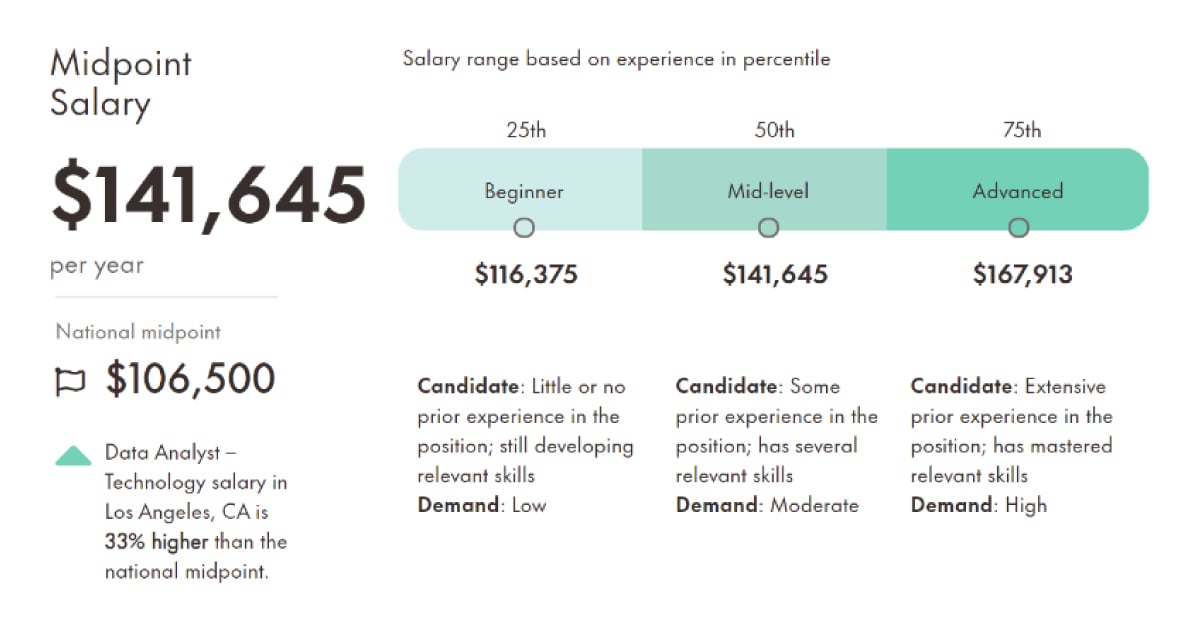
As you see from the table of labor statistics above, your skills and experience have a major influence on the salary you can command. the highest-paying roles require a specific skill set.
Data Analyst Salaries by Industry
Industries that pay the best data analyst salaries are the ones that benefit the most out of big data analytics. These include technology, healthcare, finance, and government agencies.
Let’s look at them one by one.
Technology
Data analysts play a critical role in tech companies and therefore, command top salaries. There are a few different types of tech companies and your role as an analyst in each will be slightly different, aligned to the individual company’s goals and nature of work.
Under tech services, there are four major kinds of companies:
- Information Technology (IT) companies that create custom solutions for enterprises or offer analytics services—for example, Cognizant, Infosys, IBM
- Software companies who create and sell software to end consumers. Business analytics software like Tableau or even Microsoft, Meta, Google, etc.
- Independent software vendors who build industry-specific products for other enterprises. For example, AWS, Oracle, Cisco
- Analytics solution providers handle the analytics needs of other businesses. For example, Mu Sigma, Fractal, Absolutdata, Tiger Analytics
According to LinkedIn, the average salary for data analysts in software and IT services is $65,000. Leading companies often pay much higher:
| Company | Average (In USD) | Range (In USD) |
| 99,500 | 65,700-120,000 | |
| Apple | 95,800 | 69,000-190,000 |
| Meta | 123,000 | 96,000-150,000 |
| Microsoft | 93,060 | 11,000-226,000 |
| IBM | 80,556 | 28,000-167,000 |
Source: LinkedIn and Glassdoor
Healthcare
The healthcare industry has to deal with thousands of megabytes of unstructured data daily. Hospitals and other healthcare centers seek data analysts to unscramble fragmented data from patient records, clinical trials, and billing details and convert it to usable insights.
With over 35,000 job postings on LinkedIn alone, the healthcare industry is emerging as one of the top creators of data analyst jobs. The average salary of a data analyst in healthcare is a little higher than average at $72,595. Some of the high-paying organizations are listed below.
| Company | Average (In USD) | Range (In USD) |
| GlaxoSmithKline | 92,833 | 66,000-121,000 |
| GE Healthcare | 61,042 | 55,000-77,000 |
| CVS Health | 51,631 | 51,000-59,037 |
| Acadia Healthcare | 50,000 | 48,984-53,091 |
Source: Glassdoor
Healthcare data analysts can also leverage data for:
- Diagnosis of diseases
- Drug discovery
- Recognizing potential health risks
- Recommending prevention plans
- Delivering prescriptions
- Hospital operations
- Developing strategies for customized care
- Post-care monitoring
Additionally, two key issues in healthcare analytics are privacy and security. As a data analyst, you can score a higher salary by building expertise in any of these niches within healthcare.
Government
From infrastructure to transportation, public health, and law enforcement, governments at every level deal with massive amounts of data that needs to be organized and analyzed to identify better ways of executing programs and find innovative solutions to problems. This is why many government agencies, including the FDA, the Department of Transportation, Environmental Protection Agency, NASA, the Census Bureau, FBI, and others hire data analysts.
The average pay for a data analyst in the US Federal Government is $103,734.
| Role | Average (In USD) |
| Computer Forensic Analyst | 86,878 |
| Business Analyst | 94,564 |
| Political Analyst | 109,946 |
| Operations Analyst | 116,619 |
Source: Indeed
Finance
Financial institutions and legacy banks are relying on leveraging data to stay relevant in the market and compete for profitability. Financial data analysts work in many areas and build solutions for securing customer data, classifying customers, algorithmic trading, detecting fraud, underwriting, credit scoring, risk modeling, lending, and loan appraisal, etc.
According to Glassdoor, the average pay of a financial data analyst is $64,375 but for those with relevant experience, this can go up to $200,000.
| Company | Average (In USD) | Range (In USD) |
| Capital One | 87,473 | 50,000-200,000 |
| Wells Fargo | 70,699 | 12,000-200,000 |
| JP Morgan Chase & Co | 72,690 | 42,000-200,000 |
| Centene Corporation | 69,799 | 45,000-100,000 |
Source: Glassdoor
The finance industry is a highly specialized field. A strong analytics foundation and an understanding of financial services will pave the way for a successful financial data analyst career. Familiarity with machine learning and predictive analytics are especially helpful for careers in fraud detection, security, and credit.
Negotiating for a Salary
When considering a data analyst position, apply with the goal of receiving multiple offers. You can then use this compensation information as leverage to negotiate a higher salary at your dream company. Glassdoor estimates that 17% of American employees—18% of men and 16% of women, report negotiating their salary and getting more money in their current or most recent job. By understanding your market value, you can score an extra 13% or up to $8,000. Compare offers while negotiating your salary, and make sure to consider the full package provided by each company. Include bonuses, benefits, and other perks in addition to cultural fit, career paths, and mentorship.
The best and the most important part of entry level data analyst salary negotiation is doing the research. The figure that you negotiate for should be sourced from one of the popular sites like PayScale, Glassdoor, Indeed, or LinkedIn. Quoting figures from these sites demonstrates that you have enough knowledge about your worth as a data analyst. If you have mentors, colleagues, or friends already working as data analysts in a similar industry-use the information from them for determining entry level data analyst salary.
As a fresh graduate one might not have years of professional experience but if you have worked on a certain level of specific data analytics skills do not undervalue the work you did in college. Say for example you have gained expertise in creating pie charts, plots, and charts in the college from the data. You can highlight these experiences and abilities by specifically relating them to data visualization-one of the key data analytics skills. Now that you know some top secrets on how to negotiate a better data analyst salary, it’s time to put them into practice.
Now you have a fair idea and a good understanding of how much you can make as an entry level data analyst. Whether you are planning to become a data analyst, or you just wanted this information out of utter curiosity- I hope you have found what you have been searching for.
